
Why Every Booth at an International Trade Show Needs Its Own Translation Setup
At an international trade show, language barriers do not only appear on the main stage. They happen throughout the exhibition floor, where exhibitors are presenting products, meeting buyers, answering technical questions, discussing distribution opportunities, and building relationships with potential partners from different countries. A visitor may understand the keynote perfectly and then arrive at a booth where the product demonstration or business conversation is taking place in another language. For global trade shows, translation therefore needs to reach the individual booths where many of the most valuable business interactions actually happen.
Why Each Trade Show Booth Needs Its Own Translation Setup
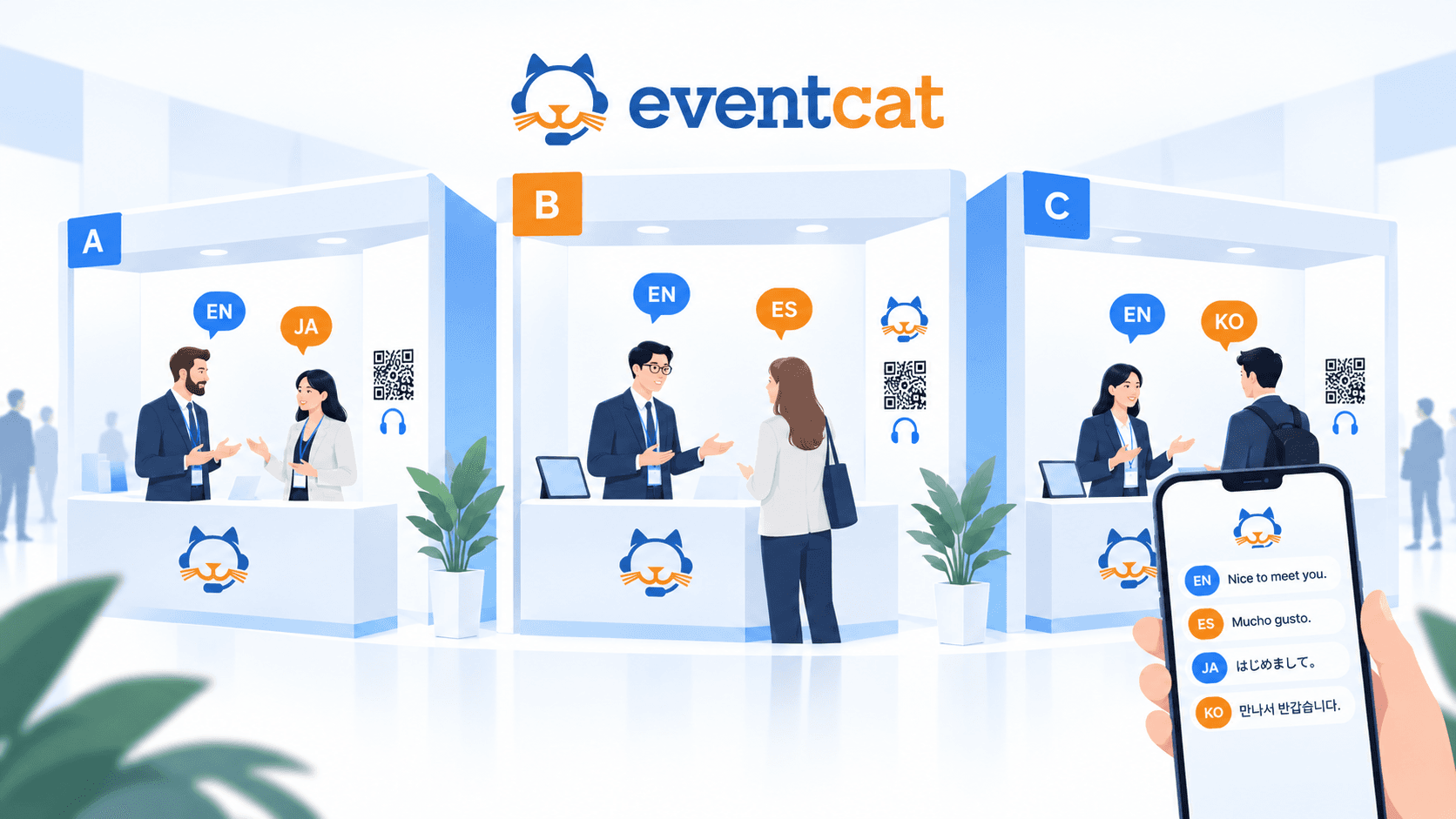
Every booth operates almost like a small event. One exhibitor may be demonstrating software in English, another may be presenting industrial equipment in German, while another is discussing products with buyers from Latin America or Asia. At the same time, dozens of presentations, consultations, and business conversations may be happening across the exhibition floor.
With separate EventCAT sessions, each booth can create a multilingual experience based on its own speakers, products, terminology, and audience. Visitors can scan a QR code, select their preferred language, and follow the presentation directly from their smartphone, tablet, or laptop. Instead of relying on one general translation stream for the entire trade show, each exhibitor can support the languages that are most relevant to its own visitors.
This is especially useful for companies running repeated product demonstrations throughout the day. A presenter can continue speaking normally while attendees follow translated subtitles in different languages. Visitors who prefer listening can also use Text-to-Speech (TTS) to hear the translated content through headphones while watching the demonstration.
Supporting Trade Consultations, Buyer Meetings, and B2B Networking
Product demonstrations are only one part of a trade show. Exhibitors also spend much of the event speaking directly with buyers, distributors, importers, exporters, investors, and potential business partners. These conversations may involve pricing, product specifications, manufacturing capabilities, delivery schedules, distribution agreements, market expansion, or future partnerships.
When both sides do not share the same language, even a promising business conversation can become difficult. Real-time AI interpretation can help participants follow discussions more easily as they happen, allowing them to focus on the actual business opportunity instead of struggling with communication. This can be particularly valuable for exhibitors meeting visitors from many different countries throughout the day, where arranging professional interpreters for every possible language may not be practical.
Trade shows are also built around spontaneous networking. A visitor may approach a booth without an appointment, ask a question about a product, and quickly move into a deeper business discussion. Because these interactions are difficult to predict in advance, exhibitors need a translation setup that can be accessed easily when needed. With QR-based access, visitors can open translated captions on their own devices without specialized interpretation equipment or major changes to the booth experience.
Handling Technical Terminology at International Trade Shows
Trade show conversations often involve terminology that is highly specific to each company and industry. A medical device manufacturer may need clinical terms to appear correctly, while a cybersecurity company may rely on acronyms, product names, and technical vocabulary. An automotive or manufacturing company may need precise terminology for components, specifications, and engineering processes.
The STT Revise Guide allows exhibitors to provide EventCAT with contextual instructions before a session begins. Companies can include product names, company names, speaker names, acronyms, and specialist terminology related to their presentation. EventCAT also offers Custom Glossaries, allowing exhibitors to define important terms and preferred translations. Together, these tools help each booth prepare its translation setup around its own products and industry rather than relying only on generic language processing.
This booth-specific approach becomes particularly important at large international exhibitions, where many industries and companies may be represented in the same venue. A single translation setup cannot easily account for every company’s terminology, languages, and presentation style. Giving each exhibitor its own EventCAT session makes multilingual communication more relevant to the conversation taking place at that particular booth.
Make Every Trade Show Booth Ready for International Business
International trade shows are designed to connect companies with buyers, distributors, customers, and partners from around the world. If a visitor is genuinely interested in a product or business opportunity, language should not be the reason the conversation ends early.
With EventCAT, exhibitors can combine real-time AI translation, live subtitles, Text-to-Speech, STT Revise Guide, Custom Glossaries, and QR access to make product demonstrations, trade consultations, buyer meetings, and B2B conversations easier to follow across languages. Instead of limiting multilingual communication to the main conference stage, organizers and exhibitors can bring translation directly to the places where international business is actually happening.
Turn every important trade show conversation into a multilingual experience with EventCAT.
Related Post
From Tohoku to the World: Real-Time AI Interpretation Demonstrated at DATERISE! 2026
Declan
Spanish Isn’t the Only Language in LATAM: How to Plan Events for Spanish- and Portuguese-Speaking Audiences
Gianella Furino
AI Beyond the Research Lab: From Research to Academic Conferences
Alicia