
Spanish Isn’t the Only Language in LATAM: How to Plan Events for Spanish- and Portuguese-Speaking Audiences
Latin America is often treated as one Spanish-speaking market, but international events quickly show why that assumption can be too simple. A conference may attract attendees from Mexico, Colombia, Chile, Argentina, and Peru while also targeting participants from Brazil and bringing in international speakers who present in English.
Suddenly, what looked like a Spanish-language event becomes a multilingual experience. The challenge is not creating a different event for every country, but deciding where language support will have the greatest impact and how different audiences can remain part of the same experience.
Start With Your Audience, Not With a List of Countries
The first question should not be how many languages an event can offer. A better question is which languages attendees will actually need to understand the content and participate comfortably.
Registration data can help organizers identify where participants are coming from, which markets are most important, what language speakers will use, and whether attendees will mainly listen or actively participate.
Before choosing the setup, it helps to ask:
Which countries represent the largest attendee groups?
Will Brazil be an important part of the audience?
Are international speakers likely to present in English?
Will attendees participate in Q&A sessions or workshops?
Which markets are strategically important for the company?
A regional product launch with an English-speaking headquarters team requires a different language strategy from a local conference where most speakers and attendees already share Spanish.
When Portuguese Becomes Essential
A LATAM strategy that automatically assumes Spanish can leave an important part of the audience behind. When Brazilian customers, employees, partners, distributors, or speakers are involved, Portuguese should be considered during planning rather than added at the last moment.
This is particularly relevant for:
regional corporate meetings;
product launches;
technology conferences;
distributor and partner events;
professional training;
webinars targeting several LATAM markets.
The objective is not to add Portuguese simply because Brazil appears on the attendee list. Organizers should consider whether Brazilian participants will need to understand detailed presentations, technical information, discussions, or training content and design the language experience accordingly.
One Stage Does Not Mean One Language
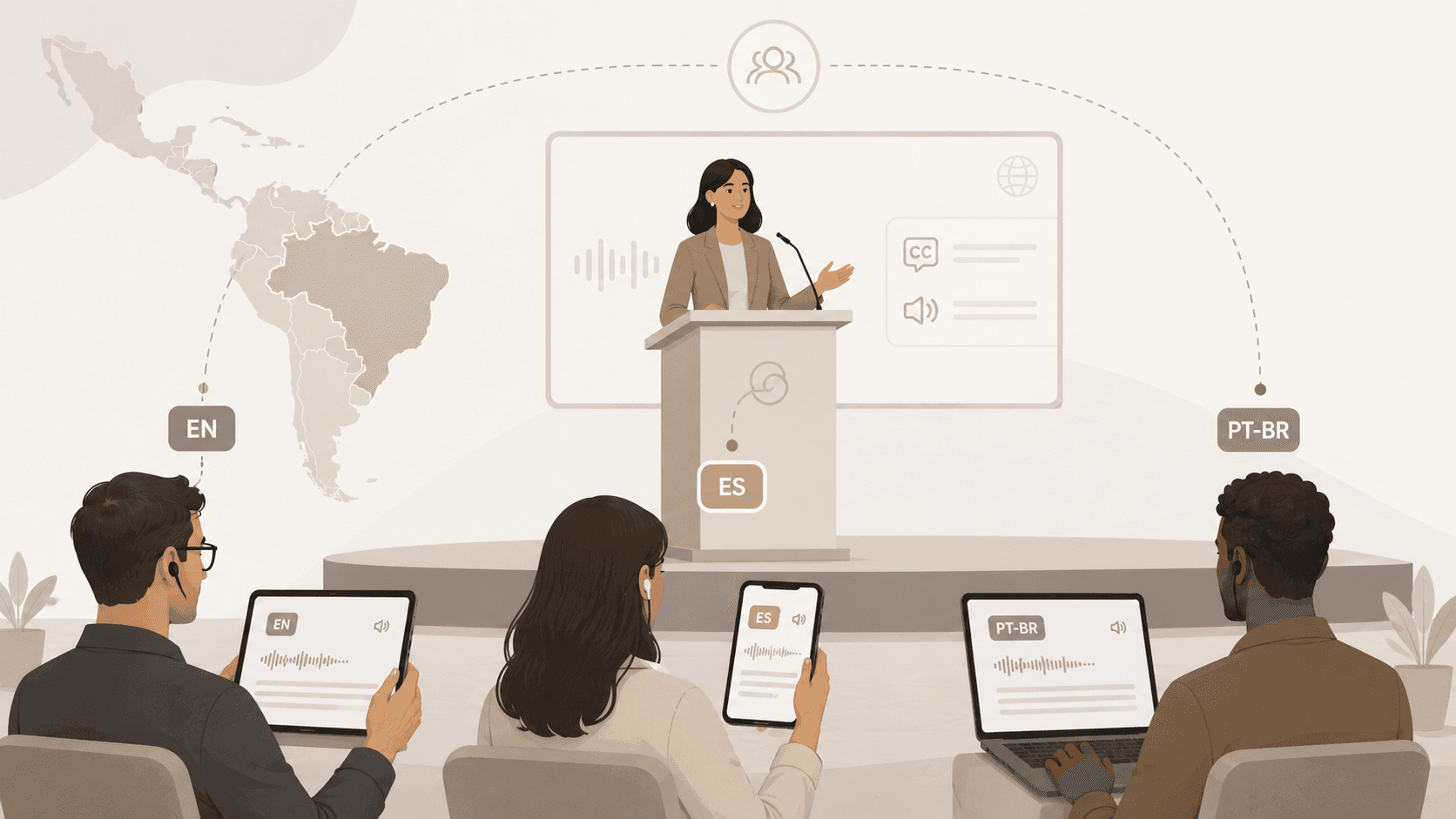
The language spoken by the presenter and the language used by attendees to follow the session do not have to be the same. A speaker may present in English while one participant follows the content in Spanish and another listens in Brazilian Portuguese.
The same idea works in reverse. A Brazilian expert can speak Portuguese while participants elsewhere in Latin America access the session in Spanish. This gives organizers more freedom to select speakers based on their expertise instead of their ability to present in every audience language.
It also makes regional events easier to scale. One keynote, panel, or training session can serve several markets without forcing every attendee to process the content in the language being spoken on stage.
Do Not Forget Q&A, Workshops, and Networking
Keynotes are relatively predictable because the speaker presents and the audience listens. Language becomes more complicated when the event moves into questions, workshops, panels, demonstrations, or networking.
An attendee may understand a presentation in a second language but still hesitate to ask a detailed question. Fast conversations, technical vocabulary, and different accents can make participation more difficult even when general comprehension is good.
Organizers should therefore consider language support in moments such as:
audience Q&A;
panel discussions;
breakout sessions;
workshops;
product demonstrations;
networking conversations.
If participation is central to the event, multilingual access should support more than the main stage.
How EventCAT Supports Spanish and Portuguese Audiences
EventCAT allows organizers to account for regional language differences instead of treating Spanish and Portuguese as completely uniform languages. For Spanish-speaking audiences, EventCAT supports Spanish and Spanish (Latin America), helping differentiate between audiences in Spain and those across Latin America.
For Portuguese, EventCAT supports Portuguese and Portuguese (Brazil), allowing event teams to provide different options for audiences in Portugal and Brazil. This is especially useful for companies running events across Europe and LATAM or regional conferences that include a significant Brazilian audience.
These regional variants are also available through Text-to-Speech. EventCAT can provide translated voice in Spanish, Spanish (Latin America), Portuguese, and Portuguese (Brazil), so attendees can listen using the corresponding regional voice and pronunciation rather than relying on one generic Spanish or Portuguese output.
Participants can access translated content from their own devices through a QR code or link. Depending on the event setup, they can follow real-time subtitles or listen to translated audio with headphones while remaining part of the same live presentation.
One Regional Event Can Serve Different Audiences
Supporting English, Spanish, and Portuguese does not have to mean producing three independent versions of the same conference. A more scalable approach is to create one main event and give attendees different ways to access its content.
For example:
Speaker language: English
Audience option 1: Spanish for Latin America
Audience option 2: Brazilian Portuguese
Shared experience: One agenda, one presentation, one live event
The model can also work with a speaker presenting in Spanish or Portuguese while other attendees access translated content. The event stays unified without forcing every participant to follow the language being spoken on stage.
Latin America may be one region, but it is not one language experience. Recognizing the role of Spanish and Portuguese, and their regional differences, helps organizers create events that can reach several markets without having to duplicate the entire conference.
Make Your Next LATAM Event Work Across Languages
Planning an event for audiences in Brazil and Spanish-speaking Latin America? EventCAT helps you provide real-time multilingual subtitles and translated audio in regional language variants, including Spanish (Latin America) and Portuguese (Brazil).
Give every attendee a way to follow the same event in the language that works best for them.
Discover how EventCAT can support your next multilingual event.
Related Post
From Sebastian Thrun to David Cameron, Access Global Insights From the World Knowledge Forum Without Language Barriers
Declan
AI Translation for International Conferences: EventCAT at Future AI Summit 2026 in Türkiye
Gianella Furino
Why Real-Time Japanese Interpretation Matters for Global Events
Gianella Furino