
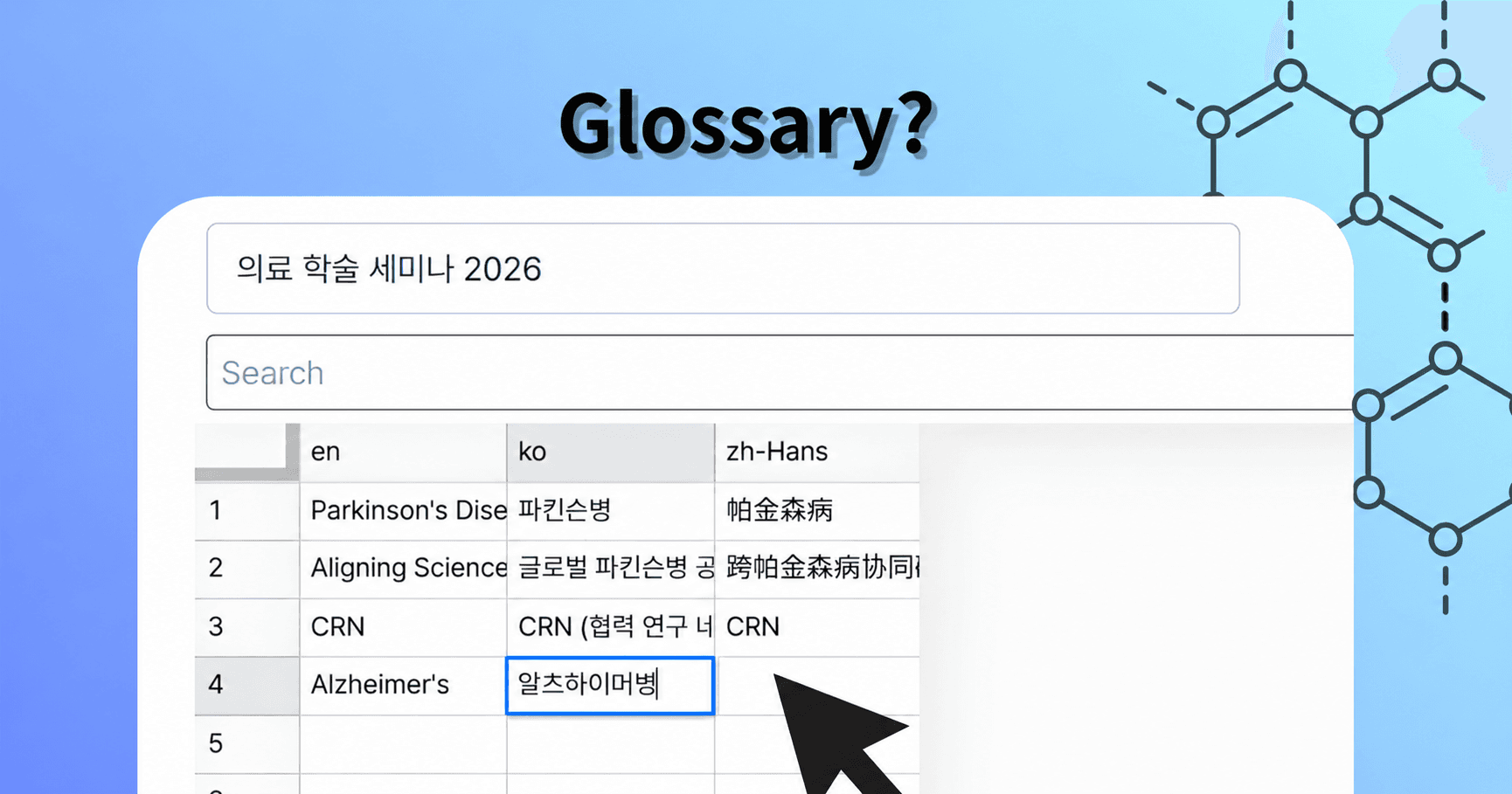
Why Glossary Features Matter in Real-Time AI Translation
In real-time AI translation, translation quality is important, but managing specialized terminology through a Glossary feature is equally essential.
In medical and scientific conferences, where complex terms such as medical terminology, abbreviations, and treatment names are frequently used, even a single mistranslation can affect the accuracy and credibility of the presentation.
AI translation services with Glossary capabilities help organizers maintain consistent terminology across multilingual events while reducing the operational burden of professional interpretation.
Professional Interpreters vs. Real-Time AI Translation Platforms in Medical and Scientific Events
In medical and scientific conferences, both human interpreters and AI-powered real-time translation platforms offer different advantages.
Category | Professional Interpreters | Real-Time AI Translation Platforms |
Strengths | Understanding cultural context and flexible responses | Consistent terminology management and multilingual scalability |
Operating Cost | Additional costs may occur for each language | License-based operation |
Multilingual Support | May be limited depending on available interpreters | Multiple languages can be supported simultaneously |
Real-Time Delivery | Possible delays during interpretation | Fast delivery through real-time captions |
Operational Risks | Fatigue during long sessions | Network and audio environment management required |
Especially in long academic events, maintaining consistency in specialized terminology throughout the session is a critical factor.
What Is a Glossary?
A Glossary is a feature that allows frequently used specialized terms and proper nouns from a specific event or industry to be registered in advance within an AI translation engine.
In medical and scientific conferences, organizers can register terms such as:
Disease names
Medical abbreviations
Treatment methods
Research project names
Pharmaceutical and biotechnology terms
Speaker and organization names
Simply put, a Glossary works as a reference list that tells AI: “This term should be translated in this way for this specific event.”
Real Medical and Scientific Events Using Customized Glossaries
EventCAT provides accurate real-time AI translation captions for various events, from small seminars to specialized medical and scientific conferences, by utilizing customized Glossary features.
Recently, EventCAT provided terminology-based real-time translation captions for the "Briefing Seminar on AI × HEALTH Global Collaboration", which focused on healthcare policy and AI technology, as well as a conference hosted by the Korean Association for the Surgery of Trauma and Critical Care, discussing the future of emergency surgery and surgical intensive care.
4 Key Features of EventCAT for Professional Academic Events
1. Generate Glossaries Based on Presentation Materials
By uploading presentation materials or event scripts, EventCAT’s AI can extract key terminology and automatically generate a customized Glossary.
Generated Glossaries can be manually edited and updated, allowing organizers to achieve more accurate real-time translation during the event.
2. Real-Time Multilingual Caption Support
Created Glossaries are applied across EventCAT’s support for more than 50 languages and used for real-time translated captions.
International participants can select their preferred language and follow professional presentations more easily.
3. Real-Time Translation Voice Support with TTS (Text-To-Speech)
In addition to translated captions, EventCAT supports real-time translated audio through TTS, helping participants understand presentations more intuitively.
4. Turn Glossaries into Reusable Assets
Glossaries created for events can be downloaded, edited, and reused in Excel format.
For recurring conferences or academic seminar series, organizers can continuously update existing Glossaries to improve operational efficiency.
How to Set Up an EventCAT Glossary to Reduce Terminology Errors
EventCAT Glossaries can be created in two ways:
AI-generated Glossary
Manual Glossary creation
Up to 800 terms can be registered per session, making the feature highly effective for medical and scientific events with a high concentration of specialized terminology.
How to Automatically Generate a Glossary
Access EventCAT Conference → Select “Create New Glossary”
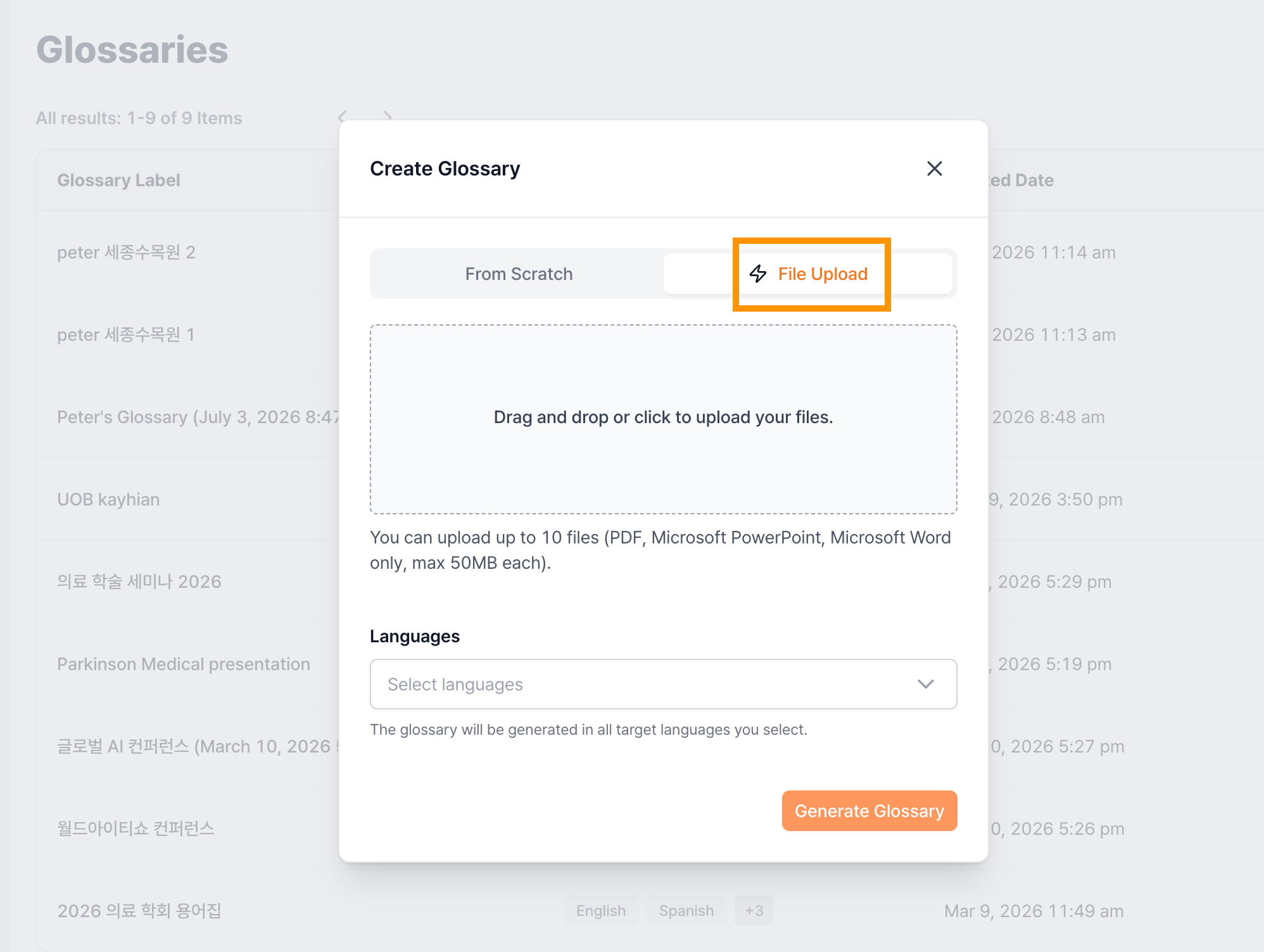
Upload presentation materials or research documents in PDF format and select the languages required for the Glossary.
Click “Generate Glossary”, and AI will automatically extract key terms and create the Glossary.
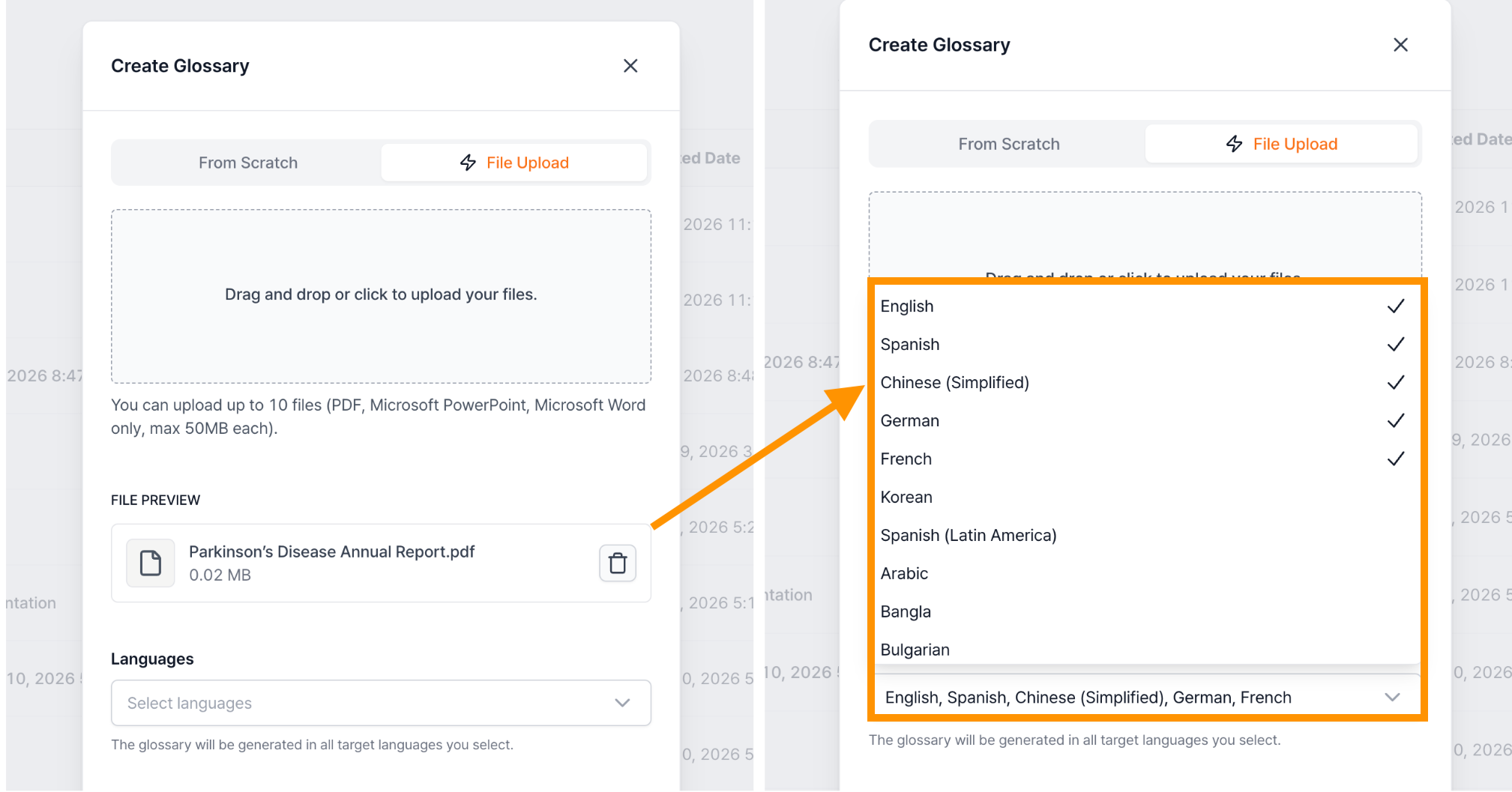
Generated Glossaries can be edited or expanded based on event requirements.
※ Up to 10 PDF files can be uploaded, with a maximum size of 5MB per file.
How to Create a Glossary Manually
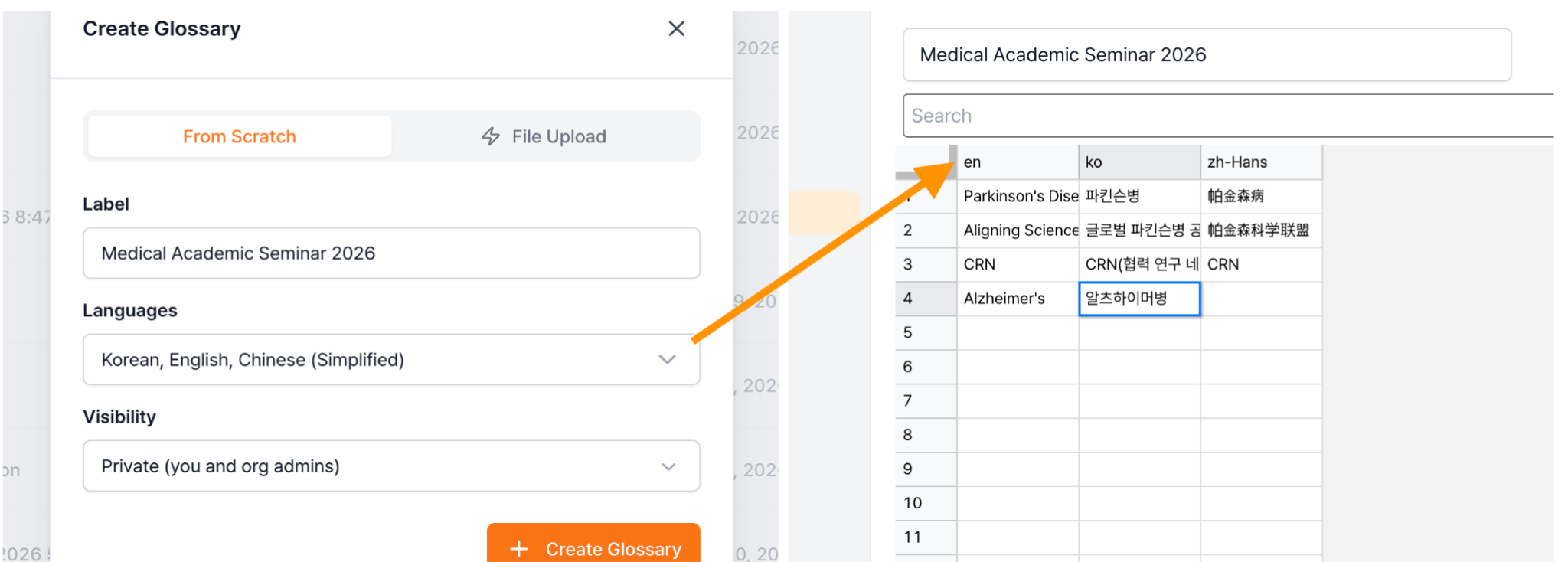
Select “Create from Scratch” and choose the required languages to manually enter terminology.
This allows event organizers to prepare translation standards in advance and create a more stable real-time translation environment.
FAQ: Is Using a Glossary Required to Improve EventCAT’s Translation Accuracy?
No.
EventCAT already provides natural and accurate real-time translation captions based on translator-reviewed data.
However, for events such as medical and scientific conferences where specialized terminology appears frequently, we recommend using the Glossary feature to further improve terminology consistency and translation quality.
In Professional Academic Events, Accuracy Matters More Than Speed
In medical and scientific conferences, fast translation alone is not enough.
Accurate terminology, preservation of presentation context, multilingual consistency, and stable long-duration operation are all essential factors.
For global medical conferences and scientific seminars, discover how EventCAT is being used through various customer success stories.
If you are looking for an AI interpretation solution optimized for international events with specialized terminology, contact us for a free demo and customized consultation.
Free Demo & Consultation: contact@eventcat.com
Related Post
Why Real-Time Japanese Interpretation Matters for Global Events
Gianella Furino
EventCAT on the Road: Real-Time AI Translation Across Japan and Korea This October
Gianella Furino
AI Real-Time Simultaneous Translation Subtitles Applied to an International Wedding — A Case of a Korean-Japanese Couple’s Wedding
Declan