Running a Global Event? How EventCAT Simplifies Multilingual Interpretation
Are you currently preparing an international event?
Once overseas speakers and multilingual audiences are involved, a whole new set of questions comes up: Where should interpretation equipment be installed? How many receivers will you need? How do you handle an unscripted Q&A? And will specialized industry terminology be translated accurately?
To help answer those questions, we’ve brought together four global events supported by EventCAT — ranging from a large-scale startup conference to a head-of-state address.
Each event came with different requirements, and the setup was adapted accordingly. Take a look at the cases below and find the one that most closely matches the event you’re planning.
At a Glance
Case | Event | Scale & Format | What This Case Shows |
|---|---|---|---|
1 | NextRise 2026 | 2-day flagship conference, 4 main stages | Real-time captions across multiple stages running simultaneously |
2 | K-Science Talent Academy Vision Ceremony | Hybrid On-site + Online | Captioning a Nobel laureate's remote keynote |
3 | SusHi Tech Tokyo 2026 | ~40,000 attendees, 8 stages | Large-scale multilingual captioning, including a Prime Minister’s address |
4 | AI × HEALTH Global Collaboration Seminar | ~50 attendees, Small conference room | A simple, lightweight setup for a small international seminar |
Case 1. NextRise 2026
Unscripted pitches and panel discussions, supported with real-time AI subtitles
COEX, Seoul | 4 main stages | Korean–English
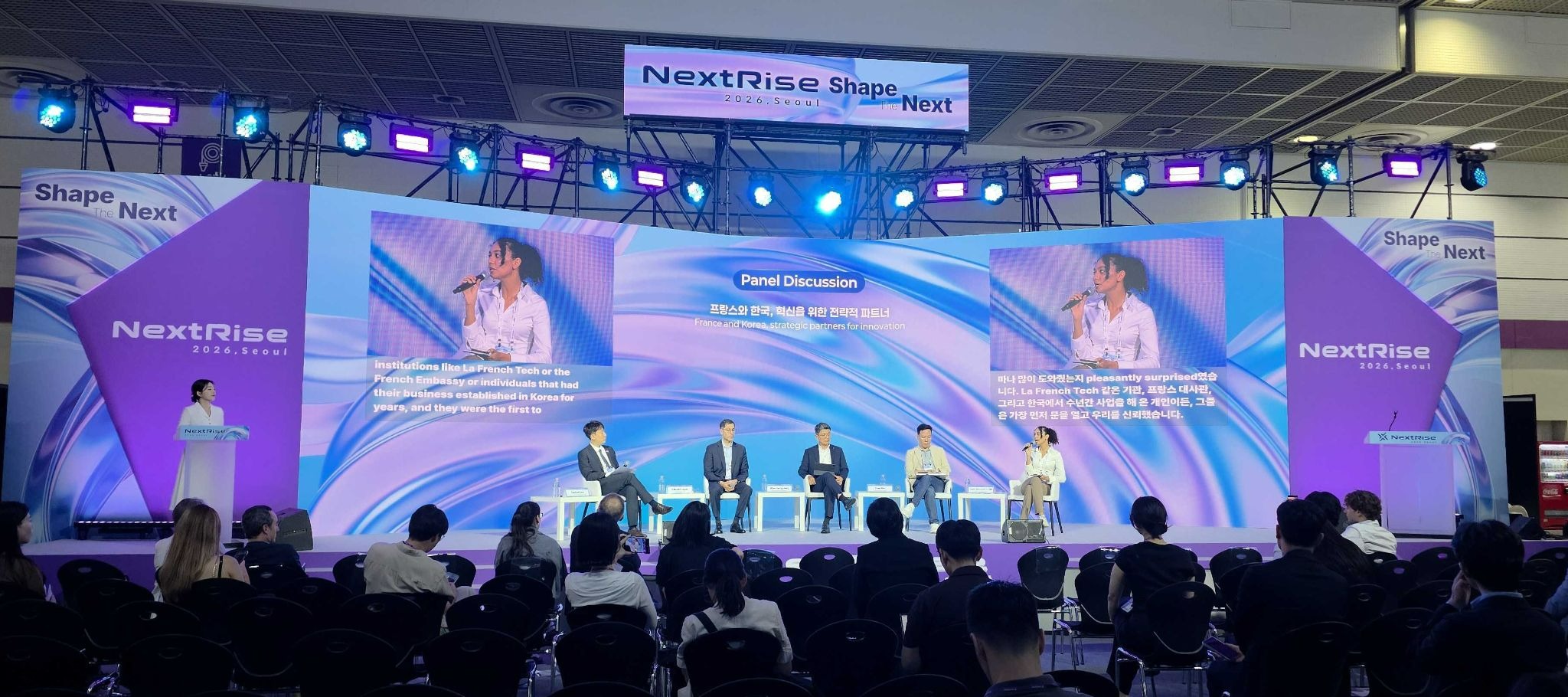
NextRise 2026 brought together startup pitches, panel discussions, and networking sessions across four main stages. Unlike scripted keynote presentations, many of these sessions involved speakers responding to questions, exchanging opinions, and introducing new topics in real time.
How were unscripted sessions captioned?
EventCAT does not require a prepared script to generate subtitles. Instead, it processes the live audio from speakers’ microphones and converts what is being said into translated captions in real time.
This made it possible to support startup pitches and panel discussions even when speakers went beyond their prepared materials or responded spontaneously during Q&A sessions. As long as the speakers’ audio was properly routed into EventCAT, the audience could continue following the conversation through Korean–English captions on the venue screens.
The system was connected directly to the venue’s existing AV setup, so captions could be displayed without installing separate interpretation booths or distributing receivers.
Preparing for industry-specific terminology
Before the event, presentation materials and key terminology can be added to EventCAT’s glossary. This helps the system recognize company names, technical terms, abbreviations, and other expressions that are likely to come up during unscripted pitches and discussions.
Case 2. K-Science Talent Academy Vision Ceremony
Live AI Subtitles for a Nobel Laureate’s Remote Keynote
Seoul Shilla Hotel | Hybrid (on-site + online) | Korean–English
[K-Science Talent Academy Vision Ceremony]
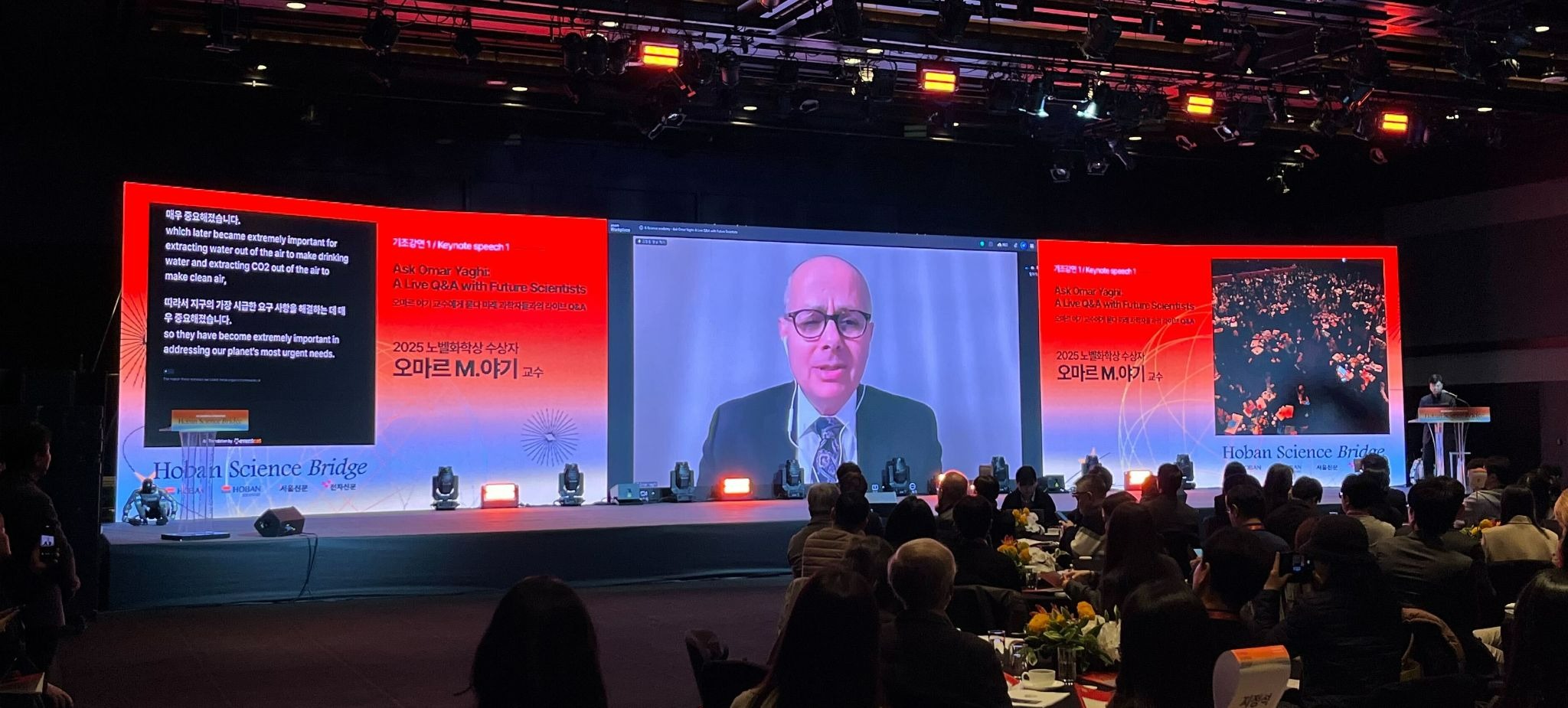
Held under the slogan “Building the Future, Connecting Talent,” the K-Science Talent Academy Vision Ceremony brought together scholars, students, and researchers from Korea and abroad. One of the key sessions featured Prof. Omar M. Yaghi, recipient of the 2025 Nobel Prize in Chemistry, who joined remotely from the United States via video call.
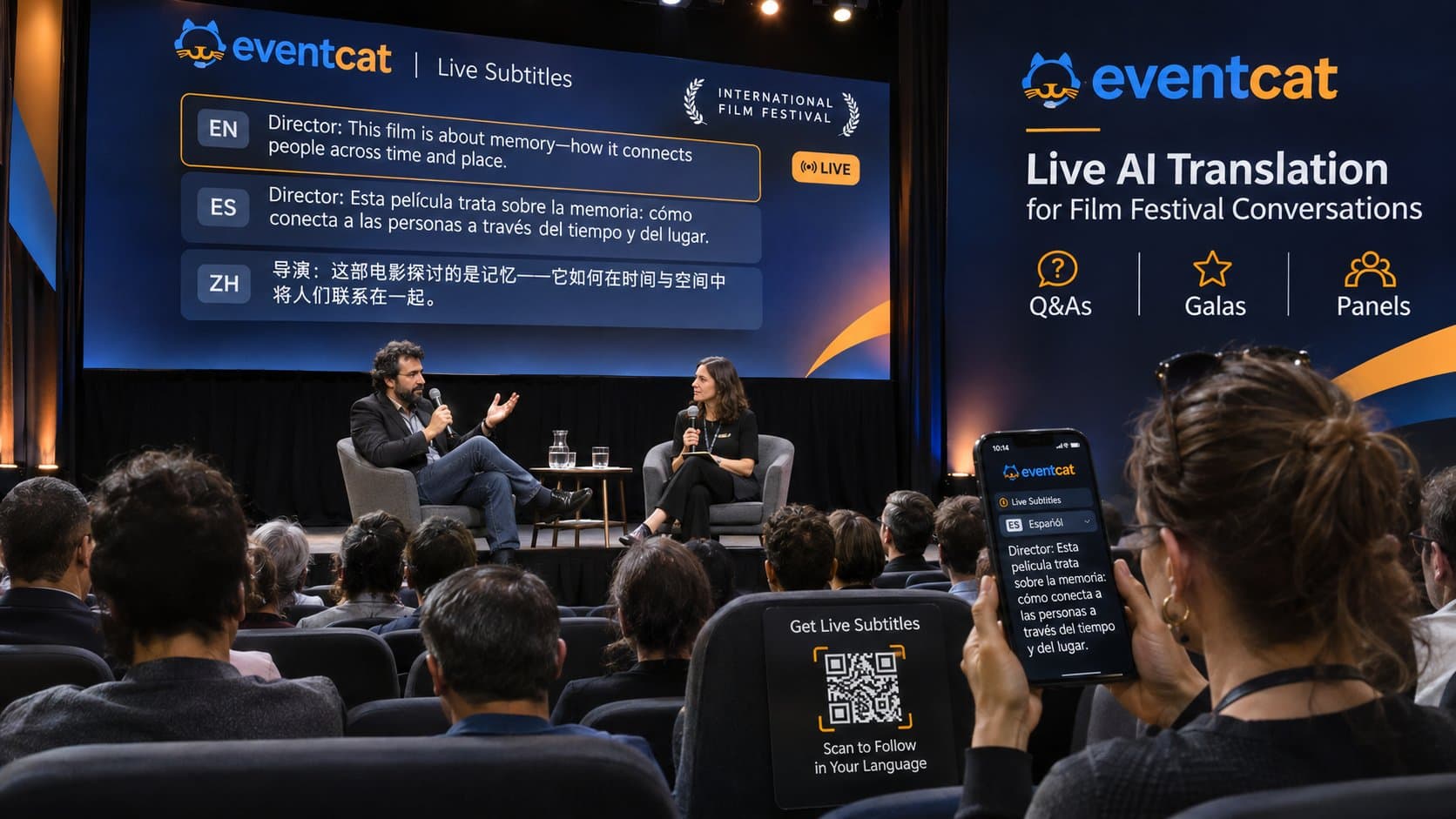
EventCAT supported the remote keynote by routing the video call audio directly into the EventCAT laptop and providing Korean–English bidirectional captions in real time. On-site attendees viewed the captions on the venue screen, while online participants followed the same captions on their own devices.
To support the chemistry-focused lecture, the EventCAT team prepared a glossary in advance with technical terms, proper nouns, and the speaker’s name. During the Q&A, a student’s Korean question was translated into English captions in real time, helping Prof. Yaghi follow and respond within the hybrid event environment.
Case 3. SusHi Tech Tokyo 2026
Supporting 40,000 attendees across 8 stages with real-time AI subtitles
Tokyo Big Sight | 8 stages, ~40,000 attendees | Japanese–English
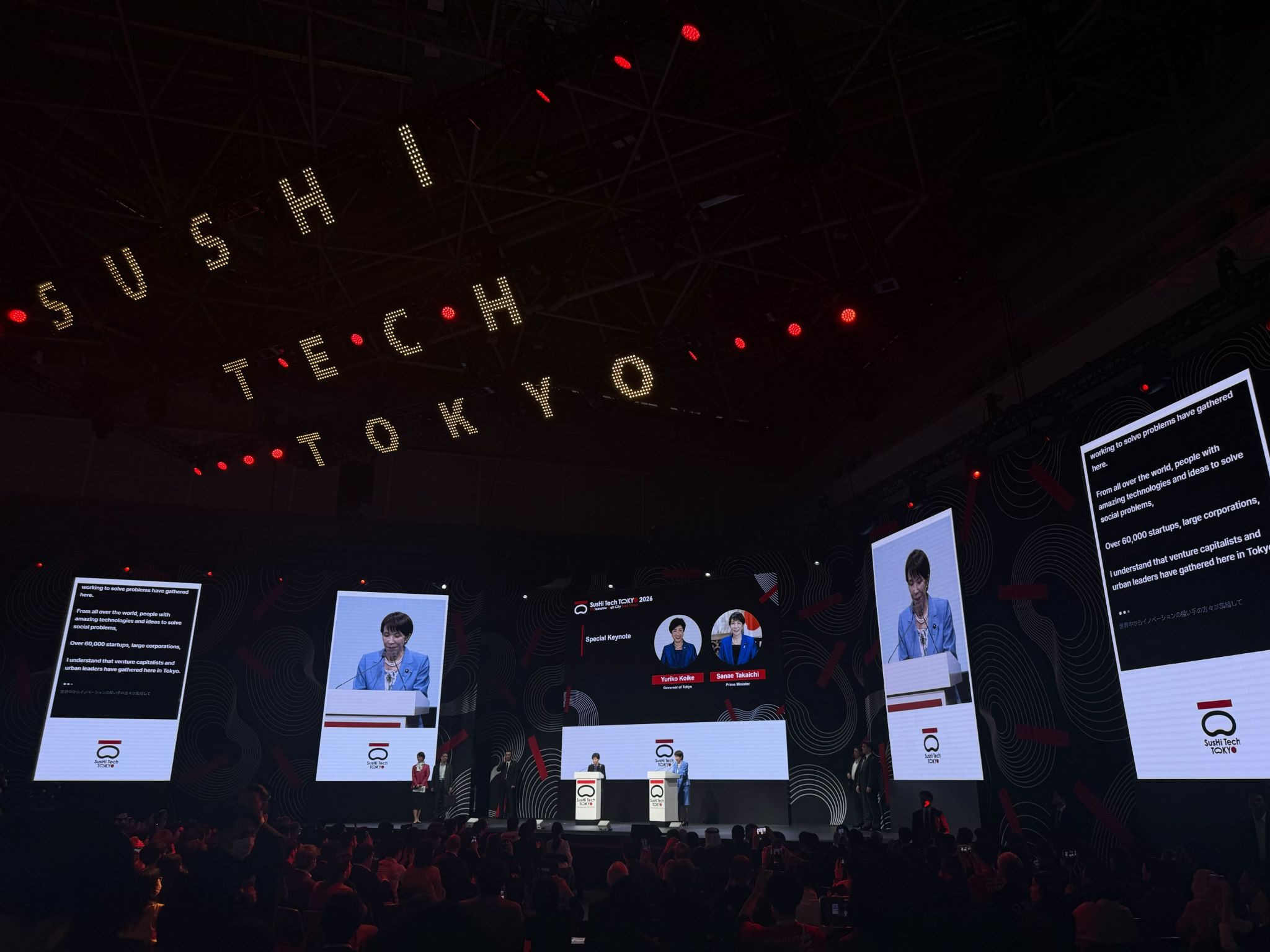
SusHi Tech Tokyo is one of Asia’s largest global innovation events. In 2026, the event took place across four floors of Tokyo Big Sight, with eight stages running simultaneously throughout the day.
As around 60% of the speakers presented in languages other than English, multilingual access was essential. EventCAT provided real-time AI captions across all eight stages, using large screens, LED panels, vertical displays, and QR codes depending on each stage setup.
Special addresses by Japanese Prime Minister Takaichi Sanae and Tokyo Governor Koike Yuriko were also captioned into English in real time.
To support an event of this scale, EventCAT engineers were deployed on site to oversee the setup and monitor live caption operations across the stages. They worked alongside the event team throughout the event to help ensure that audio, network connections, and caption displays were operating smoothly and to respond quickly if any issues arose.
Despite the scale of the event, each stage required only a laptop, a stable internet connection, and an audio input to run EventCAT. This lightweight setup, combined with on-site technical support, made it possible to provide multilingual captions across eight simultaneous stages without the extensive equipment typically required for conventional interpretation.
Case 4. AI × HEALTH Global Collaboration Seminar
Real-time AI subtitles for smaller, specialized global seminars
National Assembly of Korea | ~50 attendees | Korean–English
[AI × HEALTH Global Collaboration Seminar]
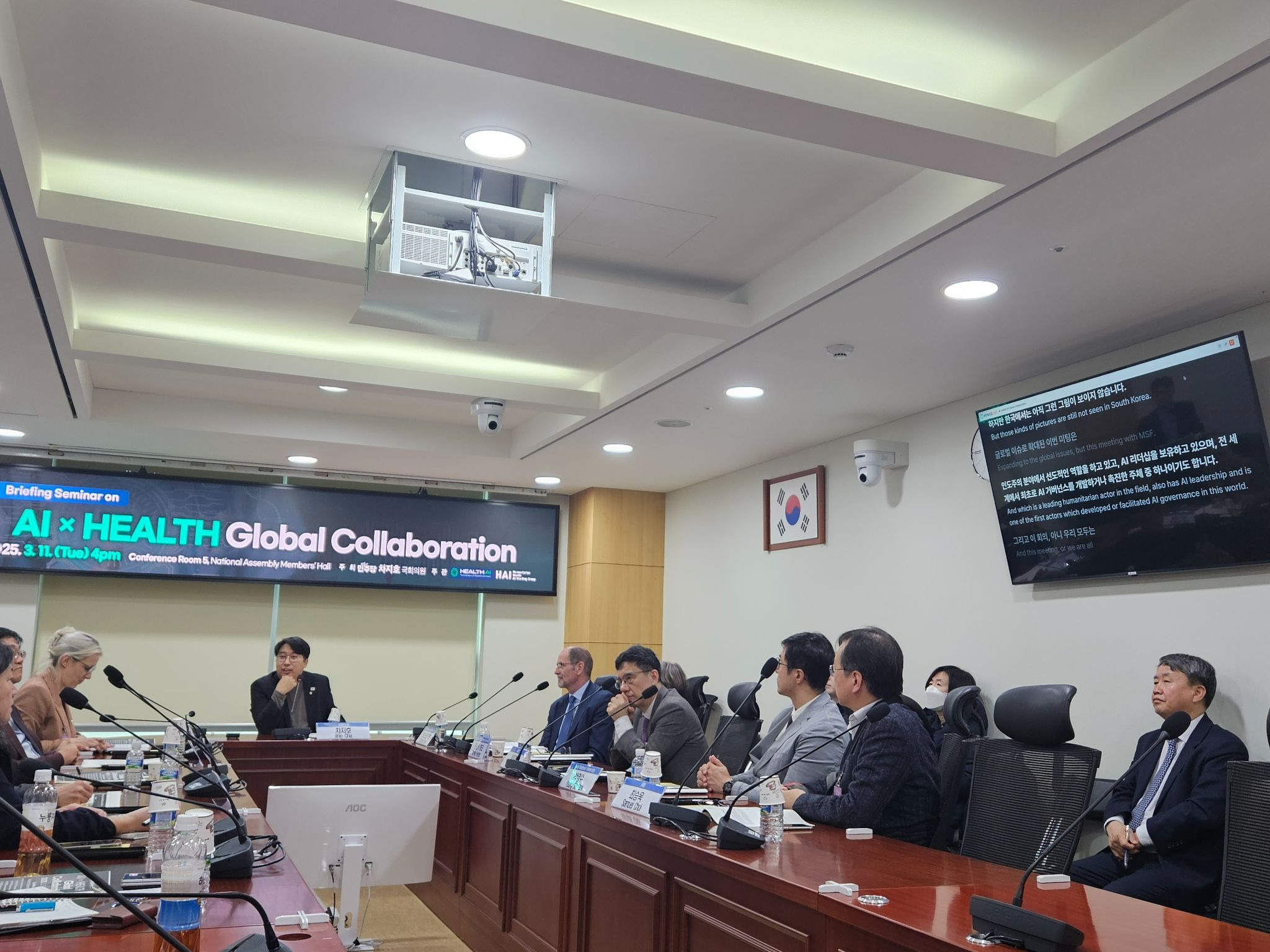
Hosted by National Assembly member Cha Jiho together with the Geneva-based nonprofit HealthAI and the Humanitarian Health AI Group, the AI × HEALTH Global Collaboration Seminar brought together speakers from multiple countries to discuss AI in healthcare systems and governance.
EventCAT provided real-time Korean–English captions on a large monitor in the National Assembly conference room. The setup required only a laptop, a stable internet connection, and an audio input, with no interpretation booth or on-site interpreters needed.
Because EventCAT supports more than 40 languages, the same lightweight setup can also accommodate events involving a broader mix of languages. This case shows how multilingual support can be implemented even for smaller, specialized international seminars without adding unnecessary operational complexity.
Which Caption Setup Is Right for Your Venue?
Every venue has different screen layouts, AV equipment, and operational requirements, so the best way to deliver captions can vary from event to event.
EventCAT captions can be provided in several ways, including:
QR code access for attendees’ personal devices
A separate caption screen or monitor
Split-screen layouts
Caption overlays on the main screen
Online video streams with real-time captions
For a detailed comparison of each option, see our related guide:
Planning an Event Right Now?
Share your event schedule and venue floor plan with us, and we’ll recommend the caption setup that best fits your event.
Based on your audience size, language requirements, screen layout, and AV environment, we can recommend the right configuration and equipment for your event.
You can also request a live demo to see how EventCAT works before your event.
Get in touch: https://www.eventcat.com/en/contact