AI Real-Time Simultaneous Translation Subtitles Applied to an International Wedding — A Case of a Korean-Japanese Couple’s Wedding
International marriages are no longer a rarity. According to Statistics Korea’s "2024 Multicultural Vital Statistics," the number of multicultural marriages in South Korea reached 21,450 in 2024—a 5.0% increase from the previous year and the highest figure recorded since the pre-COVID-19 year of 2019. Approximately one out of every ten marriages in South Korea now involves a foreign spouse. As study abroad, international career moves, and global migration continue to build up, marriages crossing borders are steadily rising worldwide.
Among these, the increase in Korean-Japanese couples is particularly striking. According to the "2024 Marriage and Divorce Statistics," marriages between South Korean men and Japanese women reached 1,176 cases in 2024, surging by 40.2% compared to the previous year—the highest level in a decade. Consequently, weddings where both Korean and Japanese are spoken in the same venue are becoming increasingly common.
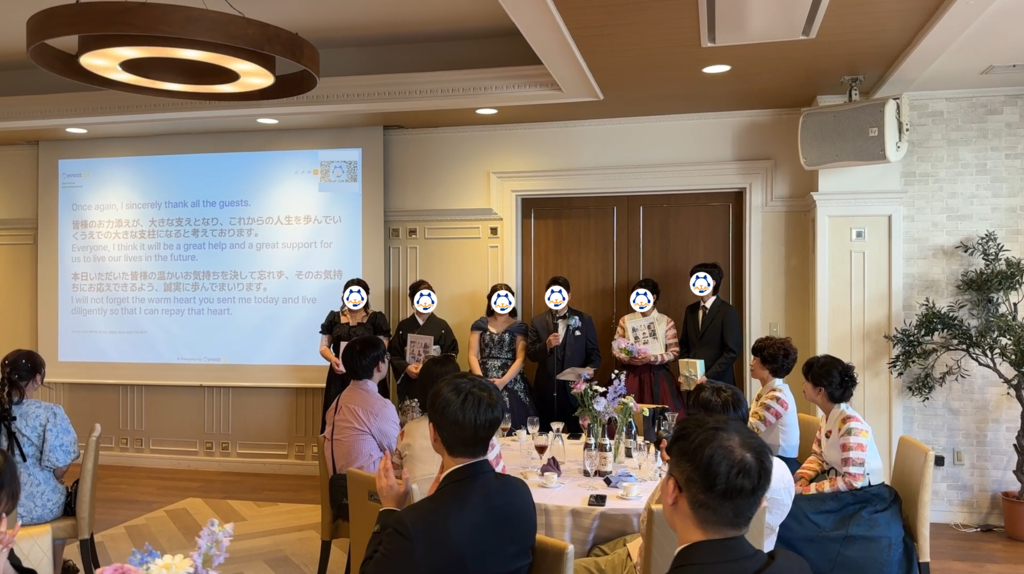
An international wedding naturally gathers guests split by nationality and language from the outset. At a recent Korean-Japanese couple's wedding held in Japan, guests speaking three different languages—Korean, Japanese, and English—assembled under one roof. By utilizing EventCAT's real-time AI translation subtitles, the proceedings led by the host, as well as greetings from the groom and bride, were delivered in each guest’s respective language. This case demonstrates how all guests were able to seamlessly follow the entire 2-hour-and-30-minute reception without hiring dedicated multilingual hosts.
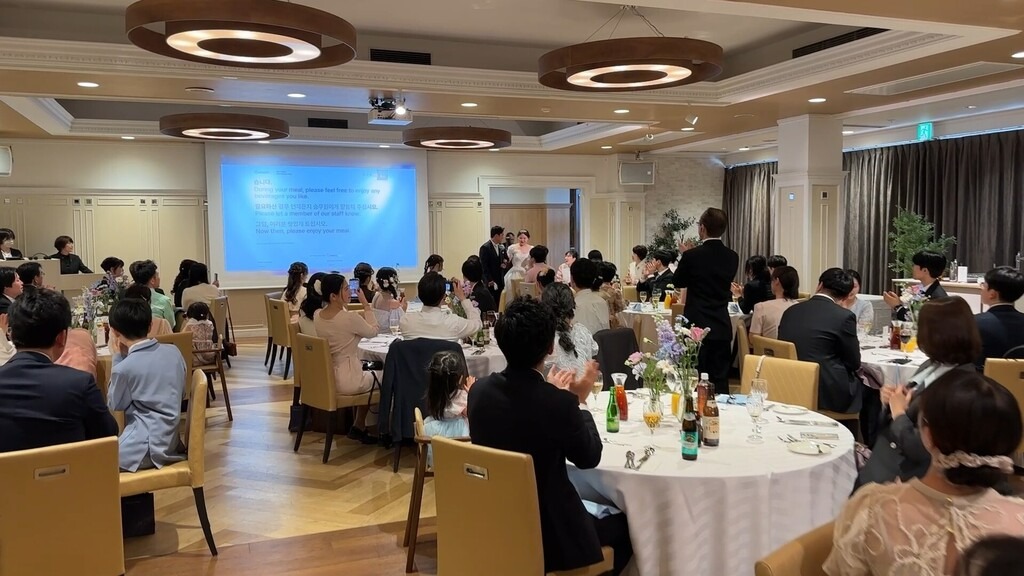
A Wedding Split Across Three Guest Languages
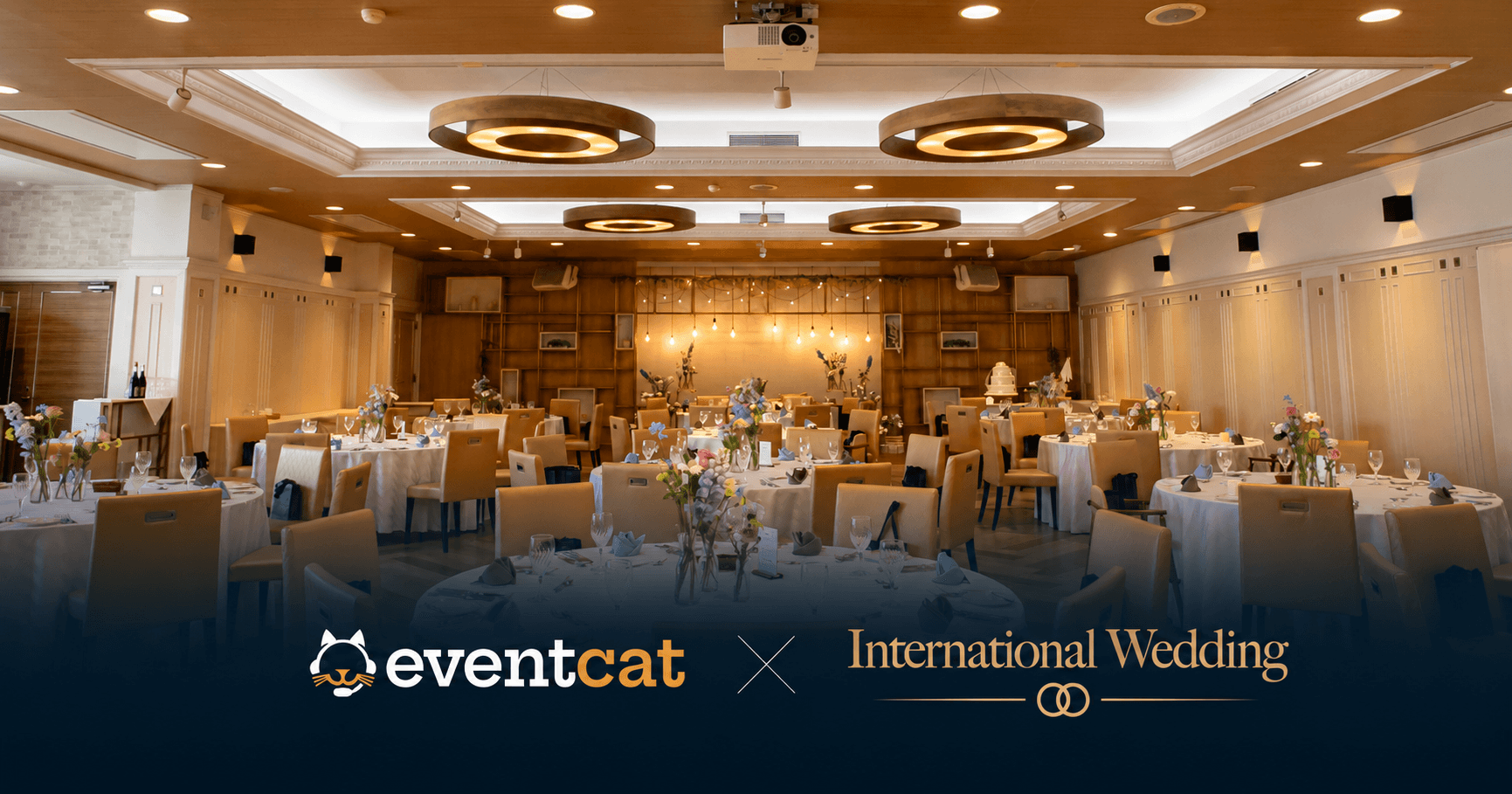
This wedding was an international marriage between a Korean groom and a Japanese bride, with both the ceremony and reception taking place in Japan. Naturally, Korean guests from the groom's side and Japanese guests from the bride's side gathered together.
However, there was an additional factor to consider. Since the bride had attended school in the United States, a significant number of her former classmates traveled from the U.S. to attend. As a result, guests whose native languages were Korean, Japanese, and English were sitting in the same space, all needing to follow the same proceedings.
Most wedding reception segments—such as congratulatory speeches, activity introductions, games, and words of gratitude—require understanding the context of the host's guidance to truly participate. If a portion of the guests cannot understand what is being said, they don't just miss out on information; they end up simply sitting there passively. This was precisely why the groom and bride proactively addressed the language barrier in advance.
The Practical Challenge of Finding a Trilingual Host
The first option considered was hiring a multilingual host. However, the couple ran into two major hurdles during the search process.
First, finding a host capable of professionally leading an event in Korean, Japanese, and English was extremely difficult. Being able to hold a casual conversation is entirely different from smoothly presiding over a wedding and reception in front of guests.
Second, hiring even a bilingual host posed a significant financial burden. Bilingual hosts are in high demand and hard to book; moreover, speaking everything twice naturally extends the runtime and easily disrupts the event’s pacing. Adding a third language to the mix was simply not a realistic option in terms of both budget and time management.
One Host, Three Languages
The solution they chose was EventCAT's real-time AI translation subtitles. With this approach, the host conducts the event normally in a single language, while the spoken words are translated in real time and displayed simultaneously on screen as subtitles.
For this wedding, the subtitle configuration was adjusted dynamically based on the spoken language:
When the host spoke in Japanese: Korean and English translation subtitles were displayed.
When the groom's side spoke or conducted segments in Korean: Japanese and English translation subtitles were displayed.
As a result, the host didn't need to repeat the same statements across multiple languages, and guests could seamlessly follow along on screen in their preferred language. The entire setup required no separate equipment like interpretation booths or receivers.
An "Airline-Themed" Wedding: Translated with Context-Aware Precision
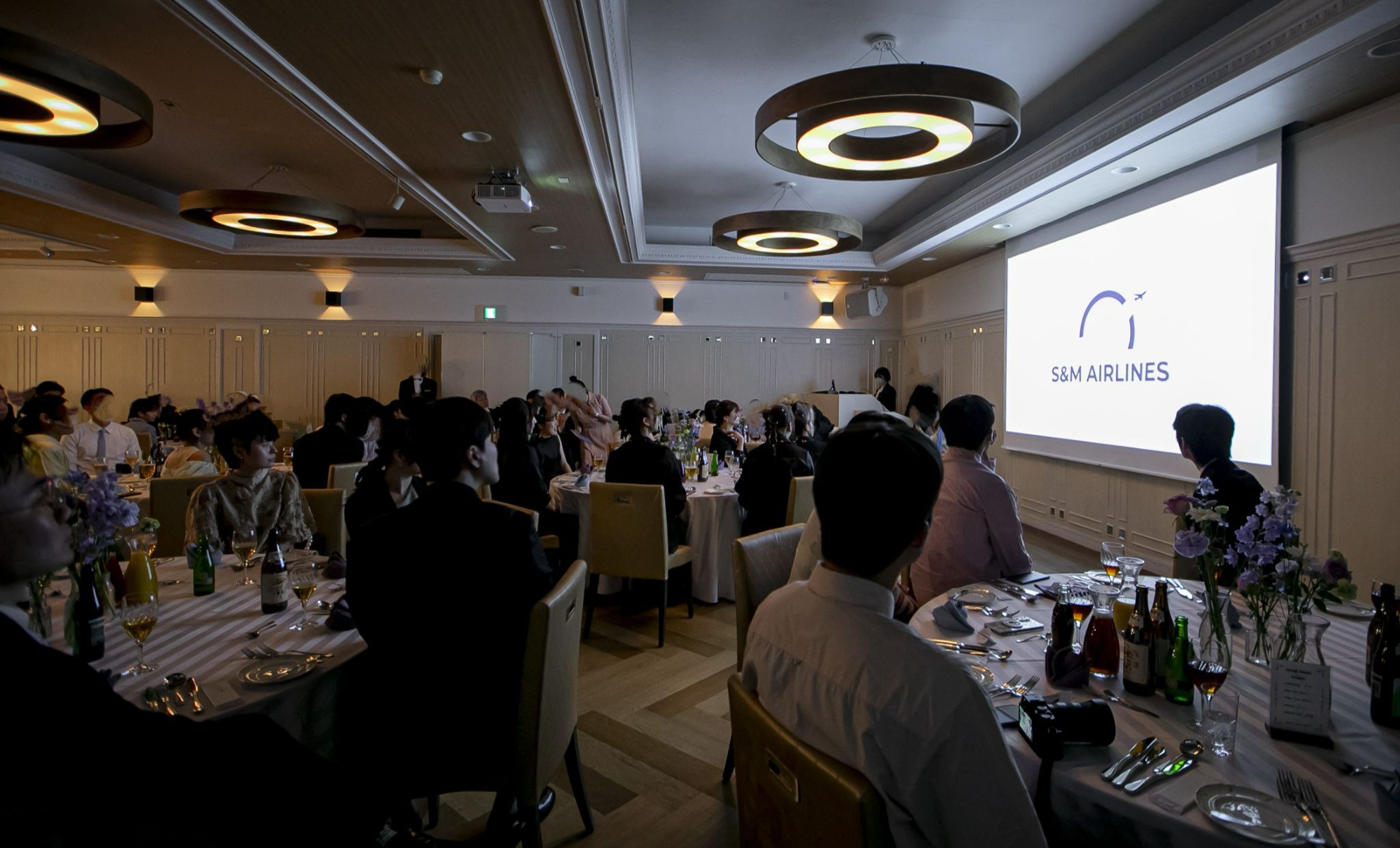
To reflect the couple's unique story as an international pair, this wedding was designed around an airline theme.
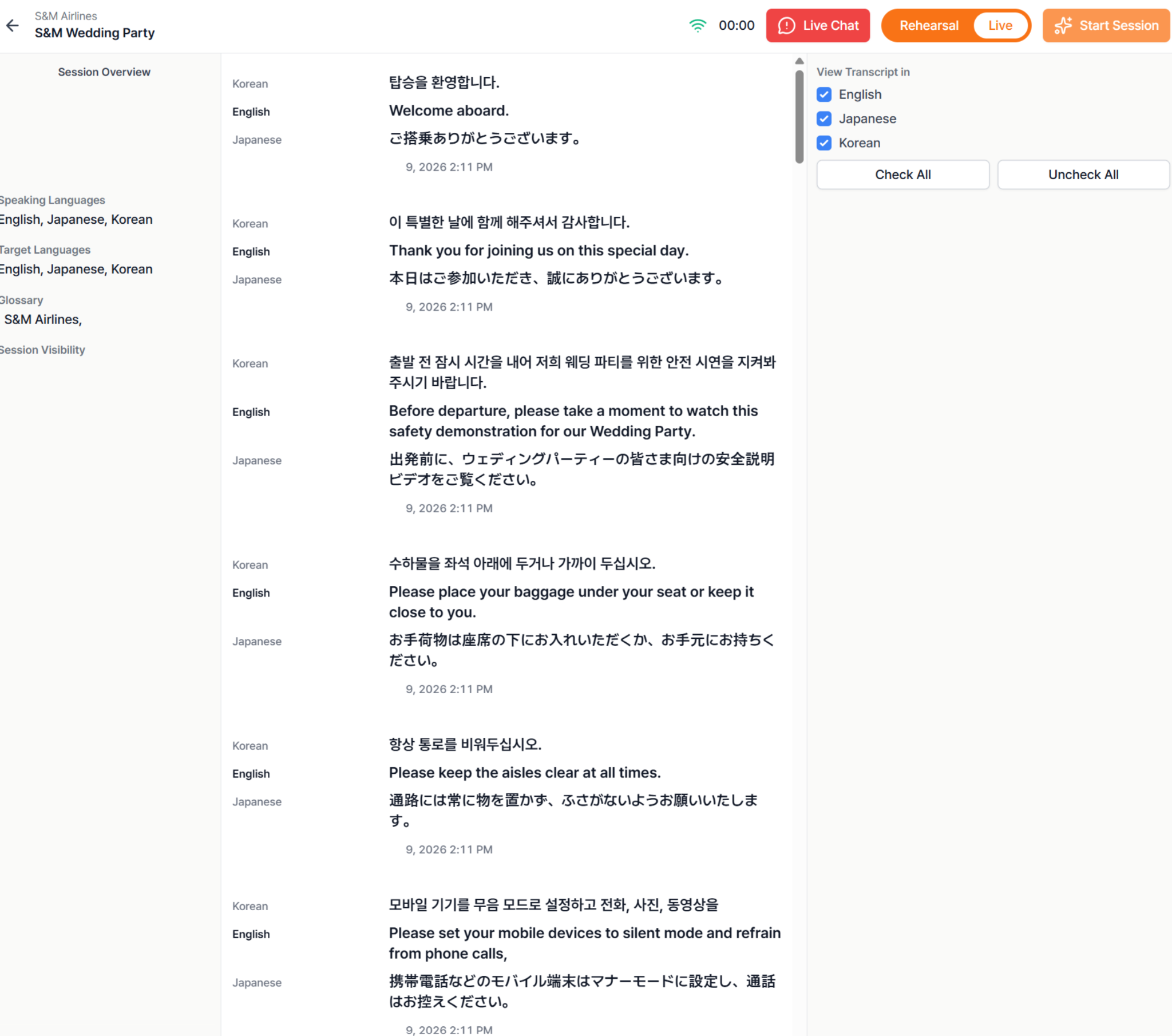
A themed wedding presents a slightly higher level of difficulty from a translation perspective because theme-specific vocabulary is used continuously alongside standard ceremonial greetings. As shown in the photo above, when the host spoke the Japanese word for "flight attendant/cabin crew," it was accurately translated and displayed as "승무원" (flight attendant) in the Korean subtitles. This was the result of selecting words tailored to the event's context rather than relying on literal, word-for-word translation.
At live events like weddings, where the script isn't entirely fixed and hosts often improvise commentary, word-level precision directly influences how well guests can follow and engage with the program.
Looking at the translation screen capture used at the event below, you can see how the translation was seamlessly delivered to match the tone and theme of the wedding.
A 2-Hour-and-30-Minute Reception: Ensuring No One Misses a Moment
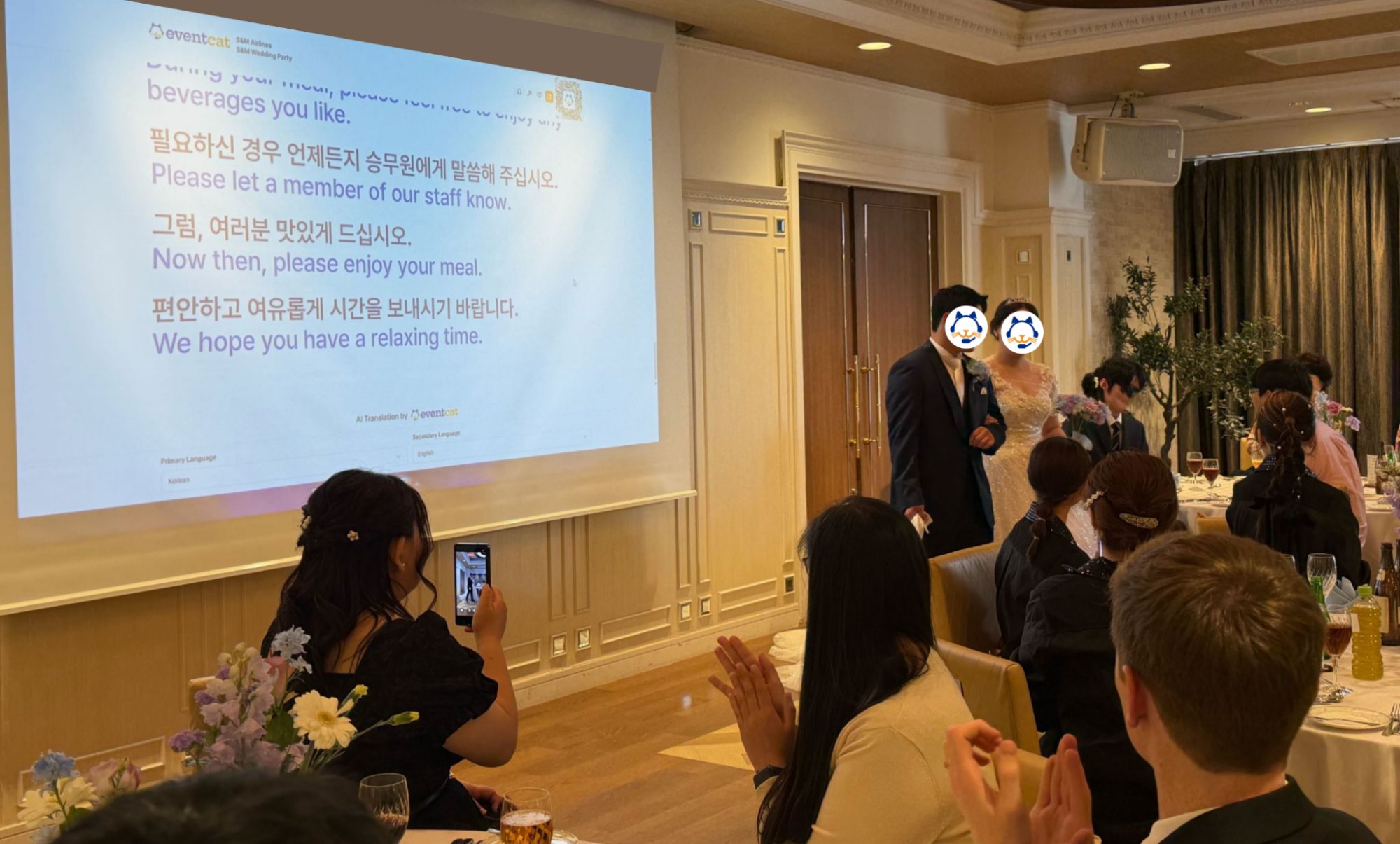
The wedding reception lasted approximately 2 hours and 30 minutes. Unlike a brief ceremony, a reception features a tightly packed schedule, including congratulatory speeches, video presentations, interactive games, and table visits. As the event drags on, guests who cannot understand the language quickly become fatigued.
Real-time translation subtitles allowed all guests to follow along throughout this extended period. Rather than providing interpretation for only select parts of the program, subtitles were present continuously, allowing guests to immediately grasp what was being discussed no matter when they took their seats.
Another key factor supporting this lengthy event with precision was pre-event training. Prior to the event, EventCAT allows users to input custom glossaries containing proper nouns that appear repeatedly—such as the names of the groom and bride, speech presenters, family members, company names, and schools.
Names are often the most prone to errors in automated translation. Korean and Japanese names can easily be misidentified as phonetically similar words or rendered with incorrect spelling. In a wedding, calling someone's name marks a special moment dedicated to them. Because these names were trained beforehand, exact names were displayed on screen whenever the host called on a guest, allowing everyone to instantly know who was being recognized.
Expressing Gratitude in One's Native Tongue, Shared by All
The closing remarks of gratitude represent the pinnacle of the reception—arguably the most meaningful moment of the entire wedding.
Expressing thanks is the most deeply personal part of the day. Because these words are spoken directly to parents and guests, conveying genuine emotion matters far more than carefully constructing foreign sentences. In international weddings with a multilingual audience, however, couples often find themselves cutting short what they truly wish to say when forced to prepare speeches in an unfamiliar language.
At this wedding, the Korean groom was able to express his heartfelt gratitude comfortably in his native Korean, with his words translated in real time into Japanese and English subtitles. Consequently, both Japanese guests and guests who traveled from the U.S. could understand and share in the exact same moment together. It was a setup that allowed the speaker to focus on his heart without language anxiety, while ensuring every listener caught every word.
Why AI Translation is Becoming the Go-To Choice for International Weddings
In addition to this Korean-Japanese wedding, EventCAT provides real-time AI translation subtitles for various international weddings—a prime example of events where multilingual communication is essential regardless of event size.
International marriages are growing steadily, and guest lists are no longer restricted to just the couple's two home countries. With expanding study abroad, career moves, and global mobility, welcoming guests from third countries has become increasingly natural. On the other hand, hiring multilingual hosts or dedicated professional interpreters remains a cost-prohibitive option within typical wedding budgets.
Real-time AI translation subtitles bridge this gap seamlessly. By keeping the host and schedule intact while simply adding the required languages as subtitles, a technology once reserved for international conferences and academic symposia is now making its way into private events like weddings.
Frequently Asked Questions (FAQ)
Can AI real-time translation subtitles be used at weddings as well?
Yes, absolutely. EventCAT provides real-time translation subtitles across various event sizes—ranging from conferences and academic symposia to private events like weddings, family gatherings, and corporate functions.
How many languages can be displayed as subtitles at once?
EventCAT supports over 50 languages and can display a single speaker's words in two or more target languages simultaneously, as demonstrated in this case study. You can configure the displayed languages to match your guest demographics.
Do guests need to install a separate app?
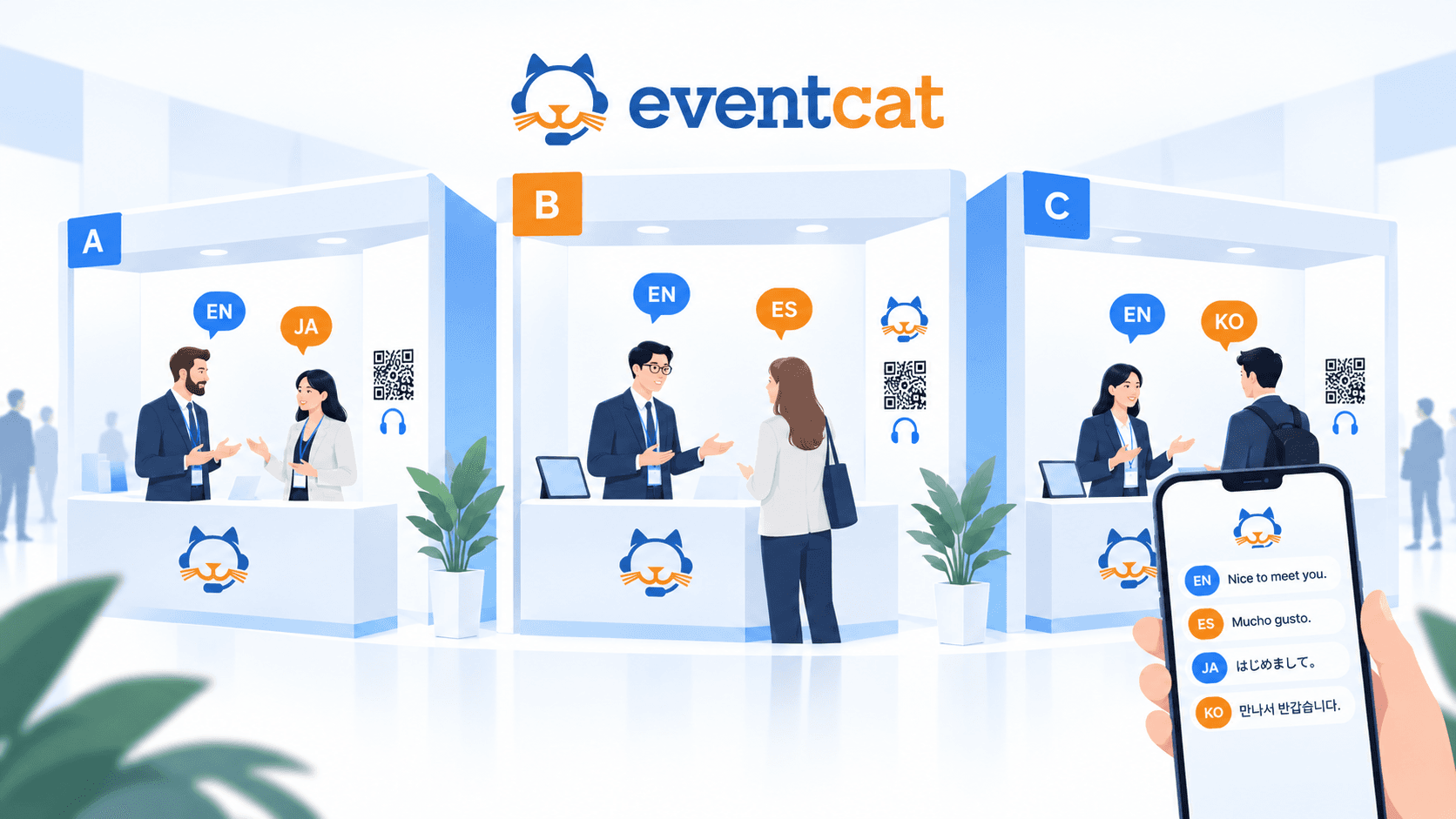
No. Guests can simply scan a QR code to view subtitles in their preferred language directly on a web browser. Alternatively, subtitles can be displayed directly on the venue's main screen.
Does it work if the host improvises without a fixed script?
Yes. Since translation occurs in real time based on spoken audio, it handles unscripted, spontaneous commentary smoothly. However, if the event involves many proper nouns or theme-specific terms, pre-registering a custom glossary is recommended to maximize accuracy.
Are specialized equipment like interpretation booths or receivers required?
No. It operates without dedicated interpretation booths or hardware receivers, placing minimal setup burden on the wedding venue.
If You Are Considering Multilingual Communication for an International Wedding or Global Event
If your guests or attendees speak two or more different languages, you can create a seamless multilingual environment without altering your host or event program. EventCAT has delivered real-time translation subtitles across a wide variety of settings, ranging from international weddings to academic symposia and global conferences. You can explore more real-time application case studies on the EventCAT Blog. We offer consultation and live demos to guide you through the ideal setup for your specific event type and scale. Contact the EventCAT team today to get started.
Inquiries: contact@EventCAT.com